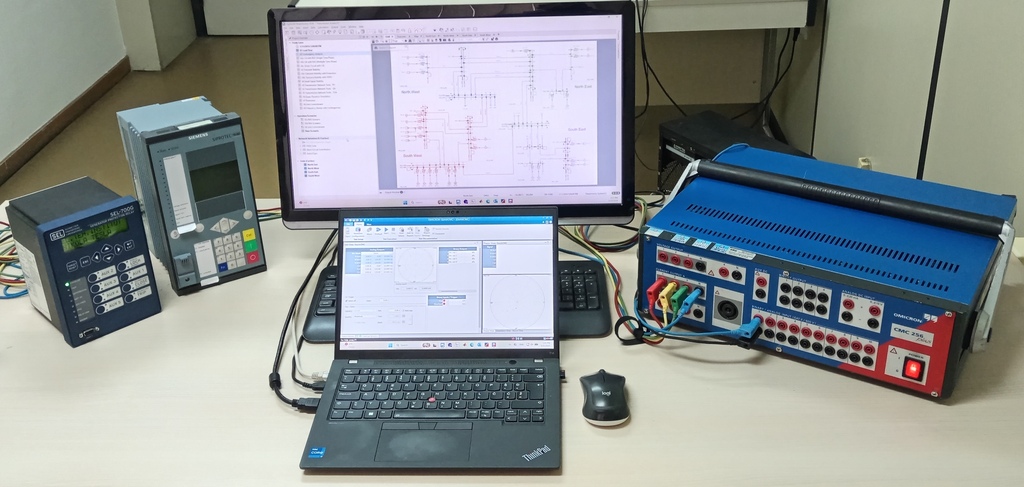
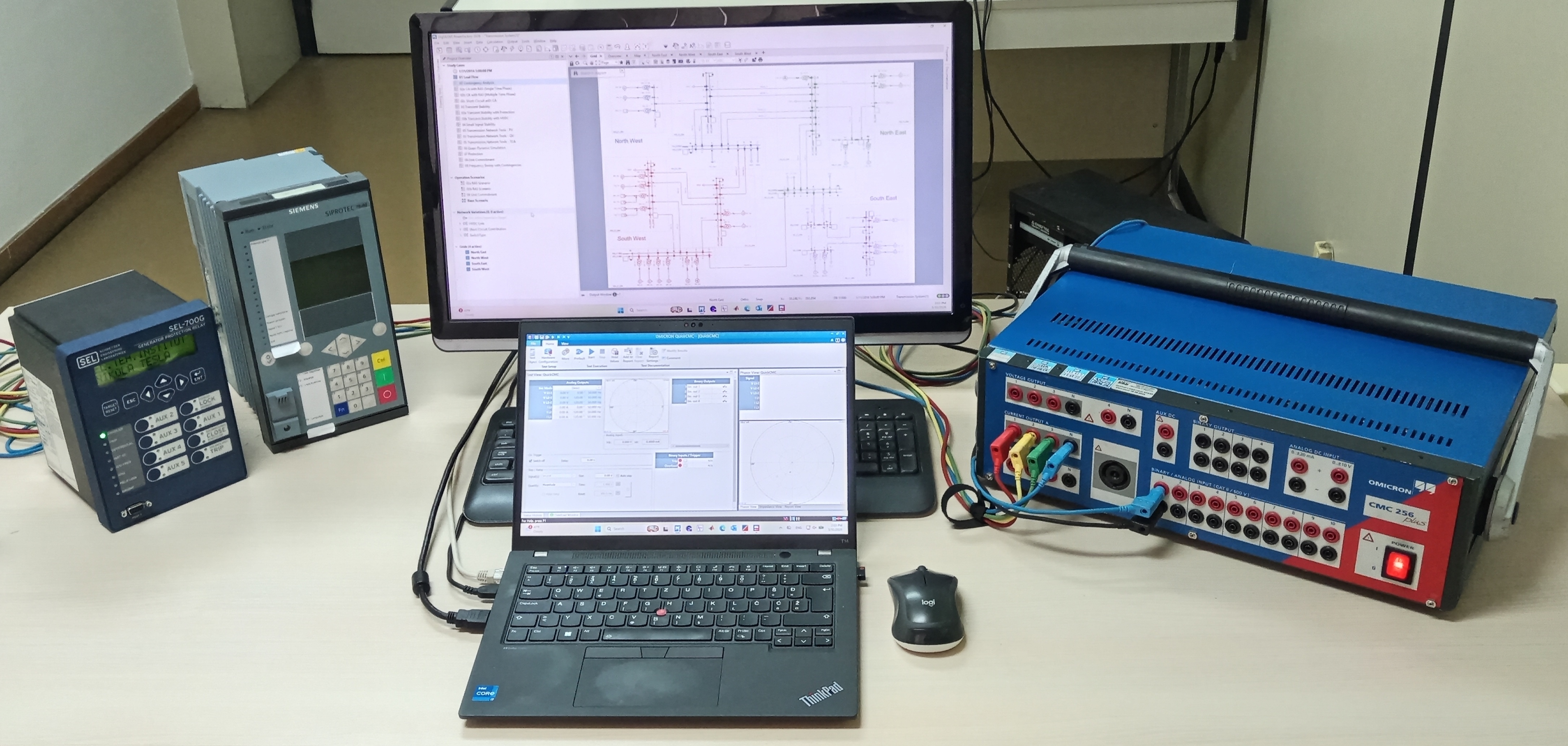

Laboratory for verification and testing of relay protection devices
Laboratory for verification and testing of relay protection devices
History
Within the Specialized Laboratory for Verification and Testing of Relay Protection Devices, a wide range of functional and verification tests is conducted to evaluate the performance of protection systems. The primary objective of these activities is to ensure the correctness, accuracy, and compliance of protection devices with applicable technical standards.
Testing procedures include the simulation of various operating and fault conditions within the power system, allowing for detailed analysis of protection device behavior under realistic operating scenarios. This approach ensures that device performance is thoroughly assessed under conditions representative of actual system operation.
The laboratory is equipped with state-of-the-art testing equipment capable of generating precise voltage and current signals, simulating different types of short-circuit faults, and verifying advanced protection functions implemented in modern numerical relays. In addition, particular attention is given to testing communication functionalities and verifying the integration of protection devices into substation monitoring and control systems.
The results obtained from laboratory testing play a crucial role in the commissioning process, enabling early detection of potential malfunctions, configuration errors, or improper settings. This significantly enhances the overall reliability, selectivity, and security of power system operation.
The Nikola Tesla Institute operates the only accredited laboratory in Serbia authorized to perform verification and certification of protection relay devices.
Main activity
Relay Protection Testing
- Comprehensive testing of electromechanical, static, and numerical protection devices
- Testing of analog and binary inputs and outputs
- Validation of protection logic and tripping schemes
- Factory Acceptance Testing (FAT)
- Site Acceptance Testing (SAT)
Protection Setting and Configuration
- Relay protection settings calculation
- Assessment and optimization of existing protection settings
- Configuration and parameterization of numerical protection relays
Hardware-in-the-Loop (HIL) Testing
The laboratory performs advanced testing of protection systems using the Hardware-in-the-Loop (HIL) methodology, enabling real-time evaluation of device performance under dynamically simulated power system conditions.
In HIL testing, a real-time digital simulator executes a detailed mathematical model of the power system, while the physical protection device interfaces with the simulator through analog and digital signals. This setup allows comprehensive testing across a wide range of operating scenarios, including complex disturbances and fault events.
Communication Systems Testing
- Testing of IEC 61850 communication compliance
- Testing of GOOSE and Sampled Values (SV) communication
- Testing of communication protocols (IEC 60870-5-104, Modbus, etc.)
- Integration testing of protection devices with SCADA and substation automation systems
Fault and Event Analysis
- Post-event analysis of protection system performance
- Reconstruction of system disturbances and fault sequences
- Evaluation of protection operation and coordination
- Preparation of detailed technical reports
.png)